From starter to a loaf to share
Print a copy to keep nearby. Where supply checkboxes appear, they last while this page is open. Photos and navigation are removed when printing.
Bill’s baking notebook • one loaf
Use the clock to make a plan, and the dough to decide when to move on.
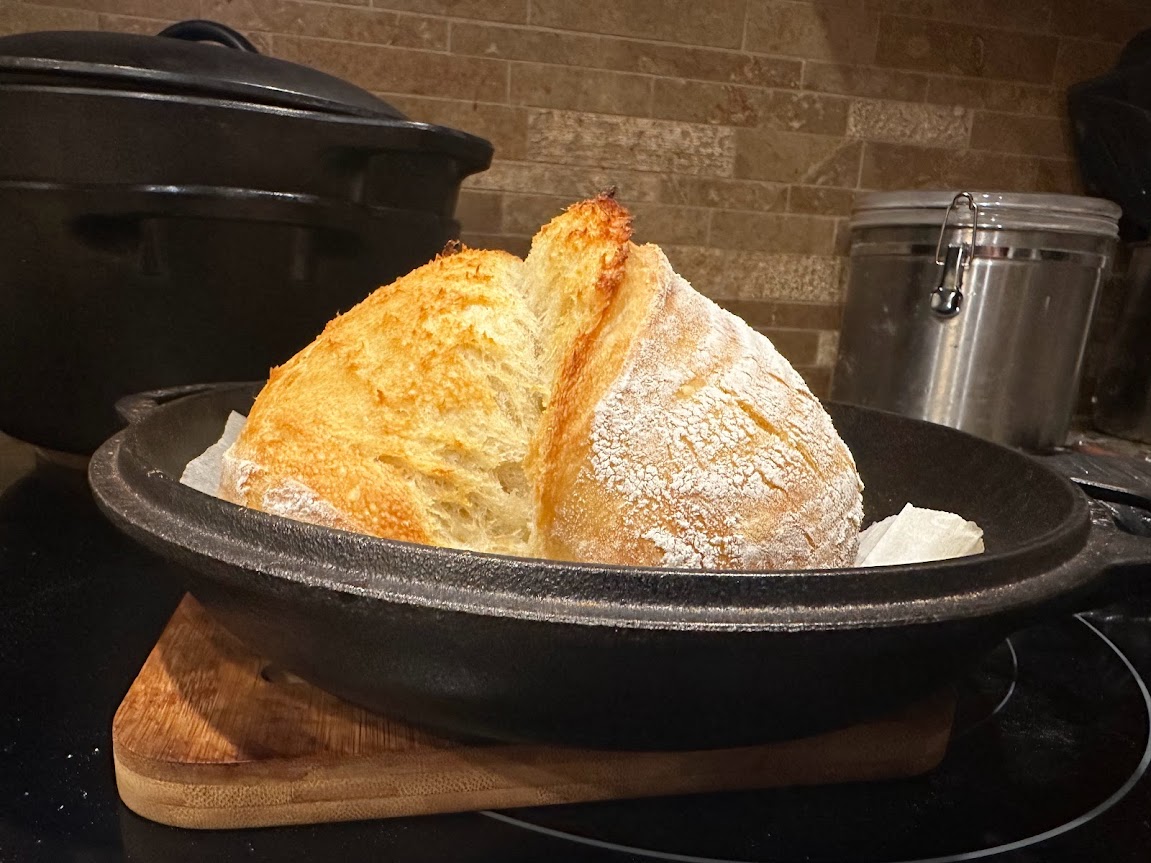
My sourdough formula
My full batch uses 2,350 g flour, 1,500 g water, 960 g starter, and 30 g salt. Dividing that batch into six gives about 807 g of dough per loaf before baking, rather than a guaranteed finished loaf weight.
| Ingredient | One loaf, rounded | Full batch |
|---|---|---|
| Unbleached all-purpose flour | 392 g | 2,350 g |
| Water | 250 g | 1,500 g |
| Ripe starter | 160 g | 960 g |
| Salt | 5 g | 30 g |
This preserves the relatively low salt amount in my formula. Starter hydration is not specified in this formula; use a consistent starter routine and expect to adjust water for your flour. The following is an expanded working guide, not a claim that this exact one-loaf version has been newly kitchen-tested.
Bill’s fresh-ground variation
For a whole-wheat variation, replace one-third of the flour you add to the dough with finely ground whole wheat berries, by weight. Keep the other two-thirds as all-purpose flour. Mill the berries into flour first; do not add whole berries directly to this dough.
For the one-loaf formula: use 261 g all-purpose flour plus 131 g freshly milled whole-wheat flour in place of the original 392 g flour. Keep the starter amount unchanged; this substitution applies to the flour added to the dough, not the flour already in the starter.
Start with the recipe’s water amount, give the flour time to absorb it, and add a little more water if the dough feels too stiff. Whole-wheat flour changes the dough’s feel, rise, and crumb; use the dough’s condition rather than the clock. This is Bill’s suggested variation, not a separately tested formula for every flour or mill.
Shop Bill’s flour picks and whole-wheat options.
Plan your bake
Allow a daytime window for mixing and fermentation, an overnight refrigerator rest, and time to bake and cool the following day. A cool kitchen or sluggish starter can extend the first rise significantly.
- Mix. Stir starter into the water, add flour and salt, and mix until no dry patches remain. Cover and rest about 30 minutes.
- Build strength. With damp hands, gently stretch and fold the dough over itself around the bowl. Repeat a few times at roughly 30-minute intervals during the early rise. Stop pulling before the dough tears.
- Let it grow. Keep covered until noticeably expanded, aerated, and more elastic. Record your starting level. Do not rely on a fixed 1½–2-hour rise in every kitchen; the dough may need several more hours.
- Shape. Turn onto a lightly floured surface, gently gather into a round, rest briefly if tight, then shape with a little surface tension. Place seam-side up in a floured proofing basket or a clean, well-floured towel-lined bowl.
- Cold rest. Cover and refrigerate overnight, around 8–12 hours as a planning window. The dough’s condition, refrigerator temperature, and earlier fermentation matter more than a fixed deadline.
- Bake with care. For an oven-safe covered bread vessel whose maker permits this use, 450°F / 230°C with roughly 20 minutes covered followed by 20–30 minutes uncovered is a starting point to adapt. Follow the vessel’s own preheating and temperature limits. Score with a suitable blade, handle hot cookware with dry oven gloves, and open the lid away from your face. Bake until deeply colored and the center is fully baked; extend time as needed.
- Cool. Move the loaf to a rack and let it cool thoroughly before slicing so the interior can set. Then note the crust, crumb, and flavor.
If the loaf surprises you
- Dense crumb: check starter strength and whether the dough had enough fermentation time.
- Dough spreads: review flour strength, water amount, shaping, and possible over-fermentation.
- Gummy inside: review bake time and cooling time before slicing.
- Dark base: check rack position and vessel guidance; adjust one variable on your next bake.
Review starter readiness · Build a baking kit
Keep blades, hot cookware, and raw dough handling with adults. For a separate tested formula, see King Arthur Baking’s country bread recipe.
Loafish Life · https://loafishlife.com/sourdough-first-loaf/